2 Days in Budapest


This path is on the Pest side and runs right along the Danube heading towards the Liberty Bridge. Part pathway, part park, part meeting spot, it was a wonderful spot to hang out on a gorgeous fall day in Budapest.

Bisected by the Danube, Budapest has a hilly side (Buda) and a flatter side (Pest), connected by a series of architecturally significant, delightful bridges.  Both sides have much to offer the visitor, from historic buildings, famous baths, fun markets, historic plazas, monuments, and fabulous architecture.  There are also spectacular views across the river, especially at night when the lights on the bridges and the Parliament building shine.

Looking across the Danube from the Buda side towards Pest and the Parliament building. Thanks to friends Lynn and Dale for this photo.

In October, I arrived in Budapest two days before embarking on a Viking Danube River Cruise.  My plan was to spend two days exploring the city (mostly the Pest side) and then to do some guided excursions, including the Buda side, arranged by Viking on the first day of the cruise.  But, as I wrote in a previous post, sometimes plans change. As it turned out, I had a wonderful two days on the Pest side, but then, due to a brief health issue, missed the day of the Viking excursions to the Buda side altogether.  Perhaps I should have titled this post ‘Half of Budapest”? 

Lively Fővám Square sits at one end of Váci Uta, a long pedestrian shopping street, just in front of the Great Market Hall, and steps from the Pest side of the Liberty Bridge.

My time in the Pest side of the city was wonderful and I was able to do one of my favorite things in any European city -  simply wander around and appreciate the architecture, plazas, and green spaces.  When it comes to architecture, Budapest does not disappoint. A walk round the city reveals graceful buildings, stone embellishments on balconies, ornate doors, towers and turrets, tree filled plazas, and huge historic buildings including the Parliament building and the Great Market Hall.

There are also monuments, large and small, to appreciate.  They reflect Budapest’s history, the glorious and the tragic.  The most moving is the Shoes on the Danube, a Holocaust memorial of made up of 60 pairs of iron shoes.  They represent the Jewish persons, adults and children, who were taken to the bank of the Danube, made to remove their shoes before being shot and falling into the river.  In Jewish tradition, many small stones are left in and around the shoes.  Ribbons, candles, and other remembrances are also left near the empty shoes. A powerful place and an important remembrance of how brutal were some periods in not so distant memory.  
On a lighter note, the smallest monuments are a series of miniature sculptures hidden throughout the city.  The sculptor, Mihály Kolodko, is known as the “guerilla sculptor”.  Some of his tiny works of art have historic or political significance and some are just plain fun. I wished that I had time to discover them all or to take the organized tour to see them.  But I found one on the Liberty Bridge, a tiny Franz Joseph, the former Hungarian King, swinging in a hammock as he overlooks the bridge which once bore his name. Another is very near the New York Cafe. I looked for the little diver there who is said to hold the key to the cafe which ws thrown into the river to make sure the cafe could never close. Unfortunately, I never found it so the photo here is from the internet). To read more about these sculptures go to https://www.budapestflow.com

Another highlight was the bridges.  The two most well-known are the Liberty Bridge and the Chain bridge.   The Liberty bridge is made of giant steel trusses in an Art Nouveau style.  It crosses the Danube from the square near the Great Market Hall on the Pest side to the Gellert Hill on the Buda side.  It has a pedestrian path, lined with ornate green iron panels and with viewpoint outcroppings that offer long views up and down the Danube.

The Chain Bridge crosses the river between Széchenyi Square on the Pest Side and Adam Clark Square on the Buda side.  Mostly constructed of stone, there are huge stone lions at either end.  This is the place for views of the Parliment Building and Buda Castle.   Both bridges are gorgeous at night.

These are just a few of Budapest’s highlights.  I will definitely need another trip to do some more exploring.

One more note.  If you are planning a stay in Budapest, I can happily recommend the Hotel Vision.  It has a prime location near the Danube River, the Liberty Bridge, and the Great Market Hall.  It was within walking distance of several interesting neighborhoods, and lively streets. The hotel also has a fabulous restaurant, Tapas Fino.  The selection of tapas and the wine list are top notch.  It is always a bonus to find great dining in a hotel restaurant; I recommend it for anyone visiting Budapest.  One other dining experience – the ornate New York Café is an old-world fantasy with musical accompaniment at dinner.  The food was good (not exceptional) but you go for the atmosphere. It was a perfect place to celebrate my friend’s birthday. Reservations are a must - otherwise be prepared for long waits (think hours not minutes) or no availability at all.

A Pause


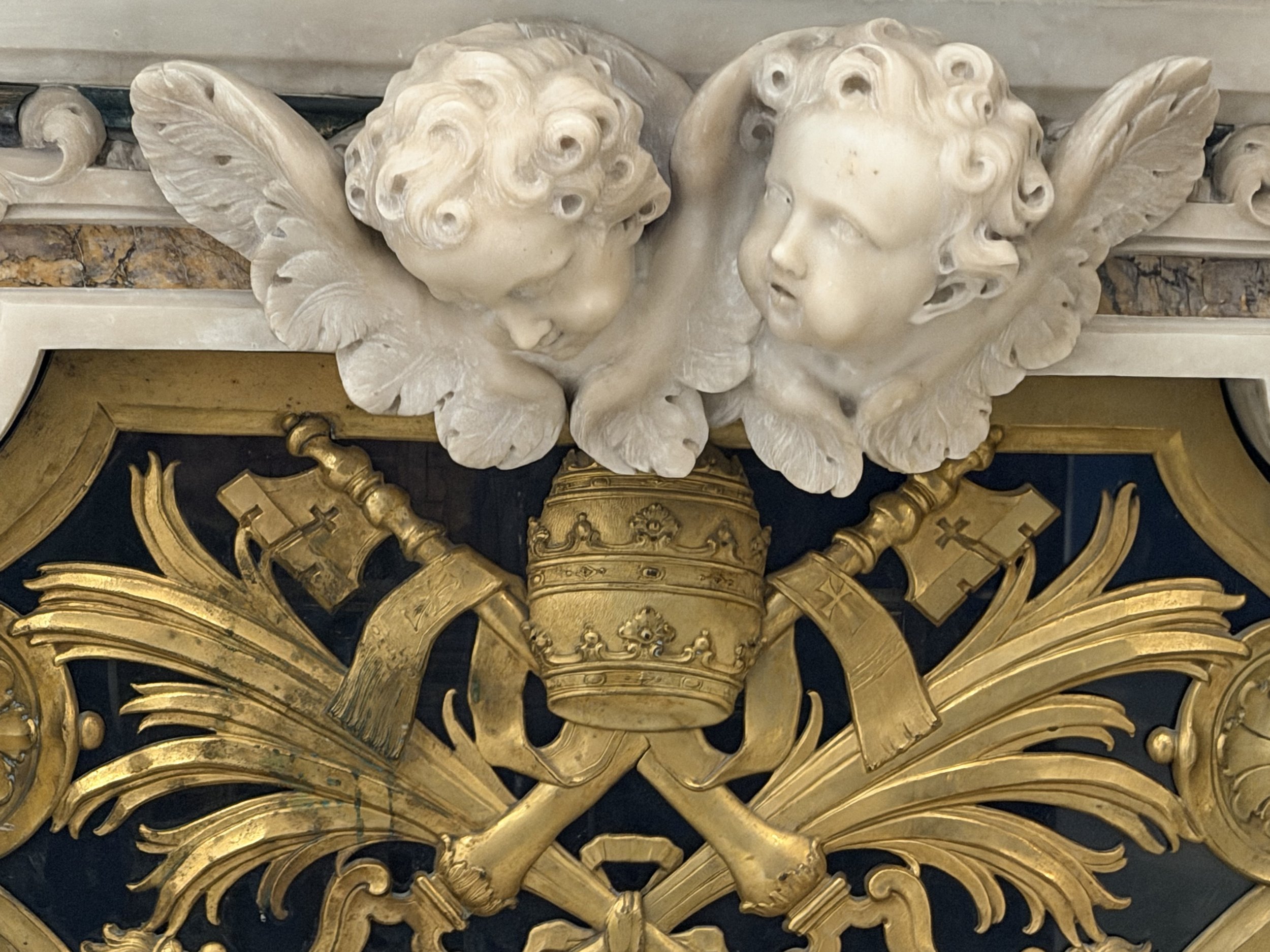
Detail from Il Compianto (The Lamentation), by Niccolò dell’Arca

Each week I try to write about something that can inspire what I think of as “living a flavorful life”.   Often the source of my inspiration is Lucca, the small Tuscan town that I consider home.  Other times, I write about Italian culture, events, food, or art. Travel, both in Italy and to other countries, is also a frequent subject.  World events play a smaller role, although in 2020 the covid pandemic became a theme for several months.  One thing I steer clear of is politics, Italian or American. This is not because politics aren’t important, but rather because there are many people who do that much, much better than I ever could. And because even in times of turmoil, we need some lighter moments.

But today I am sitting at my computer, not in Italy but in the western United States where I have been visiting my family for the last month.  And I find myself unable to share an inspiring, informing, or uplifting travel post. Doing so seems too trivial in this moment. Instead, today I need a pause. I need a chance to reset after a simply tragic week in the US which has left me feeling anxious, sad, and unsettled. I’ve heard similar sentiments from friends, family, and other blog readers.  And because I think that art is powerful, and may best capture a mood with no words needed, today I will turn to an especially powerful piece.

Il Compianto sul Cristo Morto

This group of life-size terra cotta sculptures, entitled Il Compianto sul Cristo Morto (The Lamentation over the Dead Christ), by Niccolò dell’Arca, is found in Bologna in the church of Santa Maria di Vita.  The work depicts 7 figures standing over the body of Christ after his crucifixion. I am not posting it today for its religious significance (though that is considerable), but because I don’t think I have ever seen a work of art that captures grief and horror in quite this way. It may have been created centuries ago, but those horrified, tortured, grief stricken faces still resonate today.

Next week I will return to a “normal” blog post. But this week just seems to require something different.

When Travel Plans Go Awry


Paris, December 2022. Brutally cold and Notre Dame closed for construction - but still fabulous!

February 2020, in Venice for Carnevale. After the first two days everything was cancelled due to “a virus spreading”. Talk about travel plans interrupted!

Big trips require advance planning, careful thought about travel arrangements, a clear vision of the trip’s goals, and a good measure of luck.  That is especially true in these times of expensive flights, delays and cancellations, lost luggage, and political upheaval around the globe.  Not to mention that as we get older, health issues begin to play a role. 

Travel always comes with a measure of uncertainly. 

Even with lots of preparation, some things are simply out of our control when we travel.  At times the unplanned hiccups lead to wonderful, unexpected things.  Other times, they bring disappointment.   Worse is when the problems are bigger than hiccups and threaten to upend a trip entirely. Over many years of travel, I bet we all have dealt with these issues.

Spring in Amsterdam. Who knew that the none of the cafes opened early, leaving us caffeine deprived before our canal cruise? And the cold weather meant no tulips and damp, chilly days. But we had a wonderful canal cruise, the daffodils were beautiful, and we managed not to get run over by bicycles. All in all a wonderful trip.

No tulips at Kinderdijk in The Netherlands one year due to a cold, damp spring, but the Daffodils were great!

In dealing with travel problems, it helps to know when it is not possible to go forward and rescheduling is the best option. Never an easy choice! In part this requires self-reflection and knowing just how much uncertainly or change in plans we can tolerate.  Travel insurance helps soften the blow in situations that require cancellation.  Are there times I would cancel?  Certainly.  But faced with that situation recently, I did everything possible to avoid cancelling.

Most times it is possible to have a great trip, despite some hiccups.  It is a matter of attitude, flexibility, and resilience.  I once heard someone say that if one specific thing that was important to them didn’t happen, that their whole trip would be a waste. That attitude really ups the chance of being disappointed. 

The lesson learned in Avignon - cheap train tickets are not worth being crammed into a seat holding your luggage on your lap and getting very cosy with a stranger !

It helps to choose the right travel companions – ones who you know can “go with the flow” and be unflappable in the face of some chaos and changing plans.   Luckily I have friends like that!

Instead of writing about all the great things on a trip, which is what I like to do, instead I will describe a constellation of problems on my most recent trip – an 8 day river cruise on the Danube, from Budapest to Passau, with friends.  The trip had been planned a year in advance and was fully paid, but things started to fall part a couple of weeks before the start of the cruise. Definitely some chaos, uncertainty, and stess involved.

Budapest, fabulous despite a trip full of challenges! Thanks to Lynn Bindel for this great photo.

First, my friend, with whom I was to share a cabin on the boat, had to cancel due to an emergency medical issue with a spouse. This left me as a single in my cabin – which meant I had two choices.  I could cancel my cruise too, which would be covered by my trip insurance, or I could pay a hefty single supplement to take the cruise and have the cabin to myself.  Had it just been the two of us going I would likely have cancelled.  However, I still wanted to join my other 2 friends on the trip.  Problem was that there was no way could I afford the extra fee! Travel lesson # 1 – read the insurance policy carefully.  It turns out that since the reason I would have to travel alone was that my companion cancelled for a covered reason (an important distinction), my insurance would reimburse me the single supplement minus the insurance cost.  So, while I did have to pay the extra cost up front, it only took about 6 weeks to be reimbursed and in the end cost me only a couple of hundred dollars which was the insurance cost.  I was able to join my other friends on the trip, and having the whole cabin to myself was a luxurious bonus (though I did miss my intended cabin mate).  

Budapest is where many river cruise boats stop, going either east or west. But water levels can be an issue as they were in October 2025, impacting the start of my cruise.

Next hiccup – I arrived in Budapest 2 days before the start of the cruise (always a must before a cruise), confirmed where the boat would be docked, and enjoyed a couple of days exploring Budapest. But, when I went to board the ship, well, the ship wasn’t there.

Turns out the water levels on the Danube near Budapest were dropping so rapidly overnight that there was a chance the ship would get stuck in the city and not be able to complete the itinerary. That would have seriously tested my flexibility and determination to enjoy the trip come what may! The very wise captain made the decision to move the boat 1.5 hours to the east where the water levels were more stable.  Not a big problem as buses took us to the ship the day we boarded and then back to Budapest the next day for planned excursions.  Yes, it meant extra time on a bus, but did this have a big impact on the trip?  Certainly not. Most passengers handled this well without complaint, making new acquaintances on the bus as we made our way to the boat docked in the tiny town of Komárom. 
The stunning interior of the Dohány Street Synagogue, Budapest (photo by L. Bindel)

So far, so good, except – the morning of the ride back to Budapest I woke up with an intense bout of sciatica.  No way I could do a long bus ride, I could barely get out of bed.  That meant I missed a scheduled tour of the Synagogue in Budapest, something I really wanted to do. And I missed spending time on the Buda side of town, another missed opportunity.  Was I disappointed?  Sure.  Did I let it ruin the trip?  No way.  After some medication and rest, and a relaxing day on a quiet ship, I was ok for the rest of the voyage even if I was moving slower than normal. And so grateful that I recovered quickly! After all, Bratislava, Vienna, Krems, and Passau were still to come.
I will want to plan a trip back to Budapest in the future, but am happy I had some time there before the start of the river cruise.  It’s a fabulous city. Thanks to my friend Lynn for sharing her experiences and photos from that day with me

This might be considered a tale of woe, but I don’t consider it to be so.  Although it meant some (ok, a lot of) extra work in figuring out the insurance coverage and filing for reimbursement, and I missed sharing the trip with my friend who had to cancel, and I was slowed throughout the trip with some pain - there was still so much to enjoy!  Fabulous cities, stunning fall landscapes, great food, good company.  

Travel isn’t always perfect, and often doesn’t go exactly as planned, but with flexibility and a determination to have fun, travel is well worth the challenges.  

Stay tuned for more on this cruise, starting with Budapest next week.

Sunset along the Danube, October 2025

Pasta Ortolano


Spinach pasta with ortolano sauce

One thing that I have learned living, and cooking, in Italy is that the best foods are often the simplest. There is no need to simmer sauces for hours or add 16 fancy ingredients to a dish – bright flavors, fresh ingredients, and simple preparations represent the very best of Italian cuisine.  That is certainly true when it comes to pasta sauces, be it Marcella Hazan’s famous 3 ingredient tomato sauce, a carbonara with just egg, guanciale, and cheese, or an even more simple pasta olio e aglio (oil and garlic). 

Recently I was introduced to a new (to me) pasta sauce with ingredients straight from the orto (garden) – Salsa di Ortolano.  This is a sauce that adapts to the seasons with ingredients reflecting what is fresh and readily available in the garden or market.  Lighter in spring and summer with fresh peas, fava beans, and tomatoes.  A bit heartier in fall and winter with carrots, peppers, zucchini, or mushrooms.  

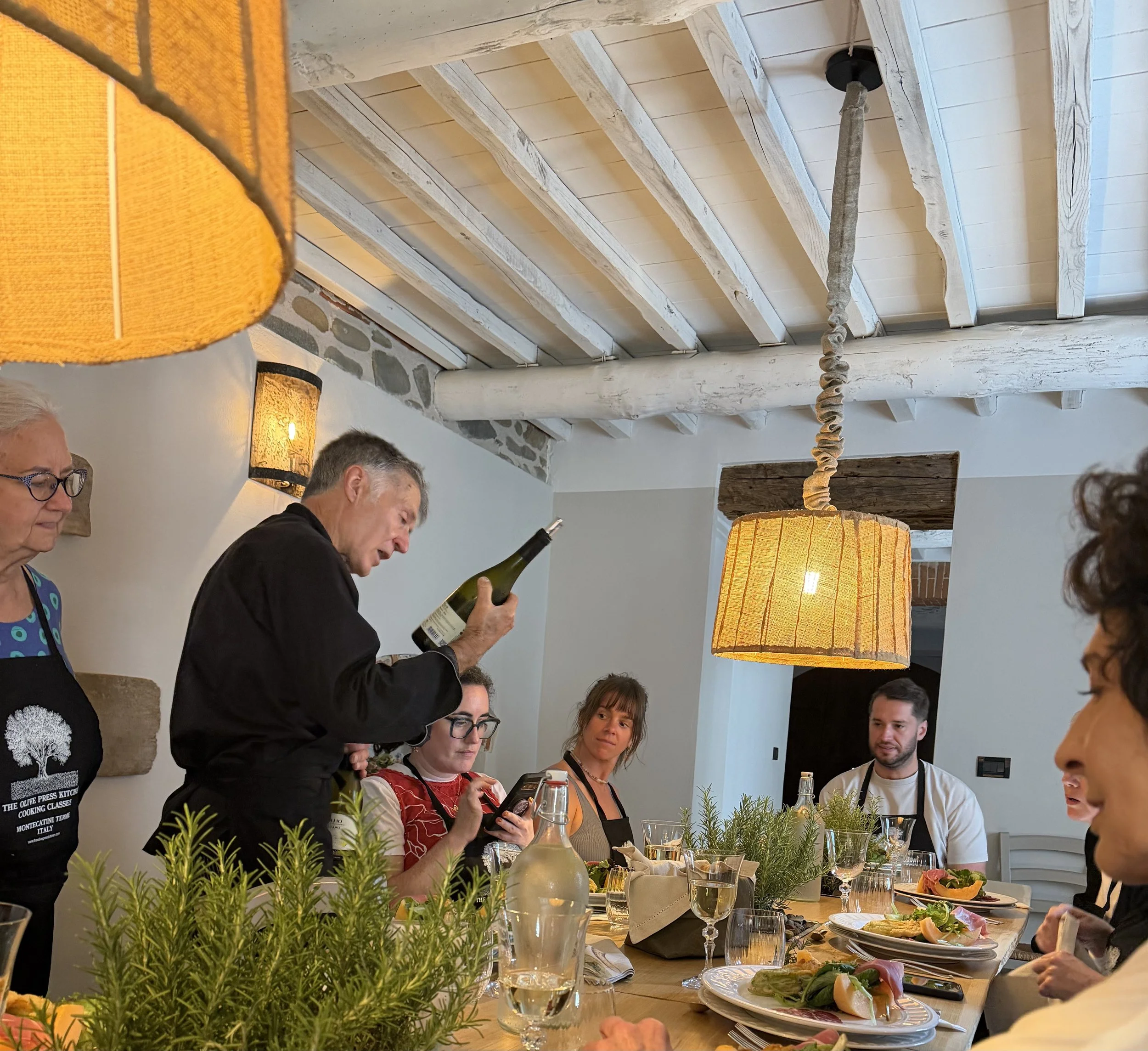
I learned to make this dish from Giuseppe, the chef at the Olive Press Kitchen, during an informal cooking session and lunch with friends.  The main event that day was making Necci (see post from Oct 13,2025) but first came lunch – a wonderful spinach pasta with salsa di ortolano.

First, a demonstration by talented pasta maker Rosetta.  She mixed just a few ingredients (type 0 flour, some semolina, an egg, cooked spinach, a drizzle of olive oil), briefly kneaded it, and proceeded to roll out, by hand, the thinnest sheet of pasta I have ever seen.  The pasta was then cut into rough squares, called maltagliata (literally badly cut) dusted with flour, and set aside to dry.   I would share the recipe if only she had used one! 

A simple homemade vegetable broth is a key ingredient in the pasta sauce

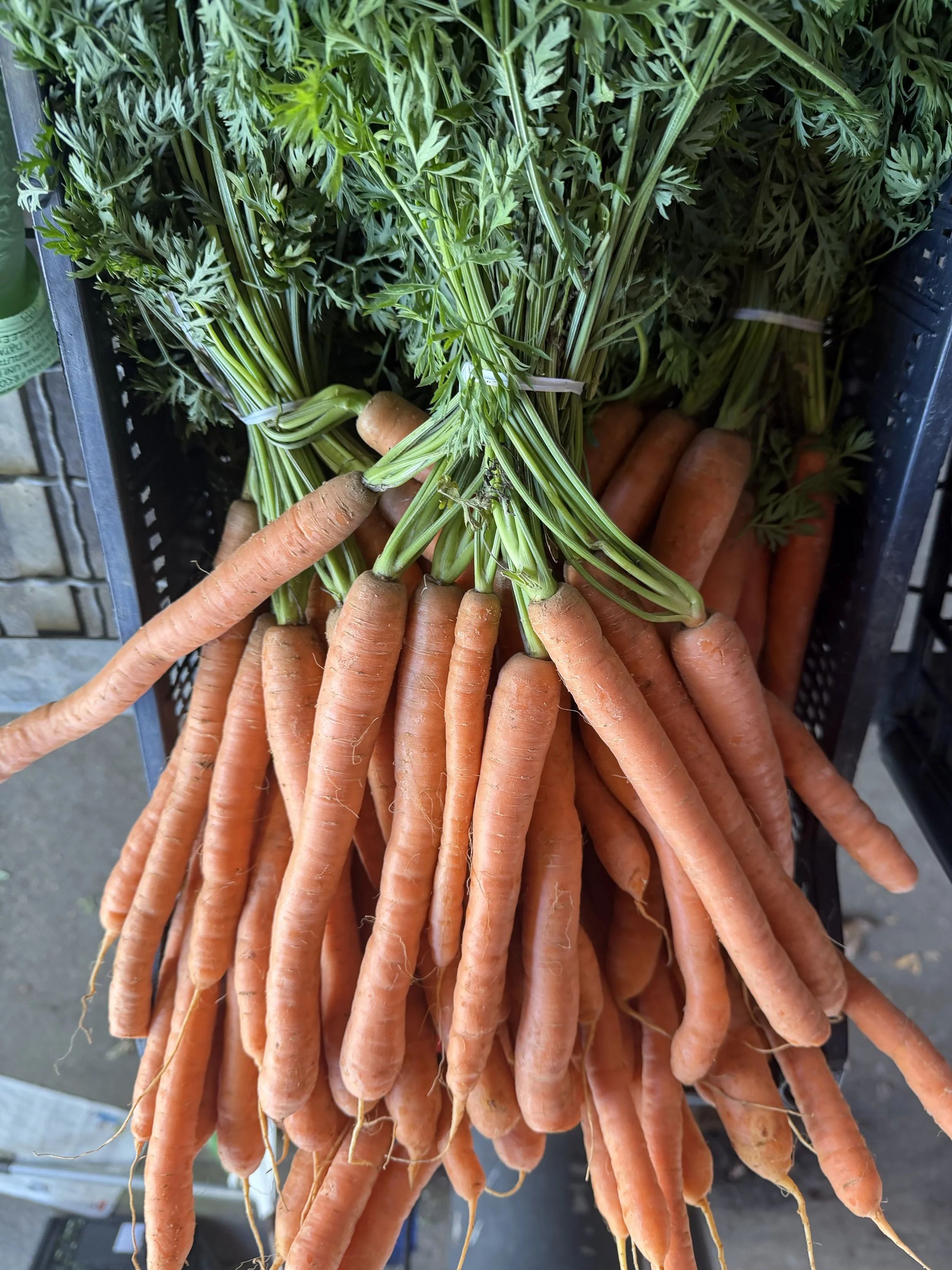
Next – the ortolano sauce.  The preparation began with a homemade vegetable broth.  Again, just a simple concoction, 1 carrot, 1 stalk of celery, an onion, two small tomatoes, a few herbs.  

Seeing how simple yet flavorful this broth was makes me embarrassed to admit to ever having used those little vegetable boullion cubes.  Shame on me!  Never again. 

While the broth simmered, we got to work preparing the sauce.  Again, there was no recipe.  We used celery, peeled yellow and red peppers, leeks, carrots, zucchini, and asparagus.  All fresh from the market.  And some good Extra Virgin Olive Oil too.

Preparation for the sauce began with peeling the peppers and then dicing them, along with the other vegetables, into small pieces

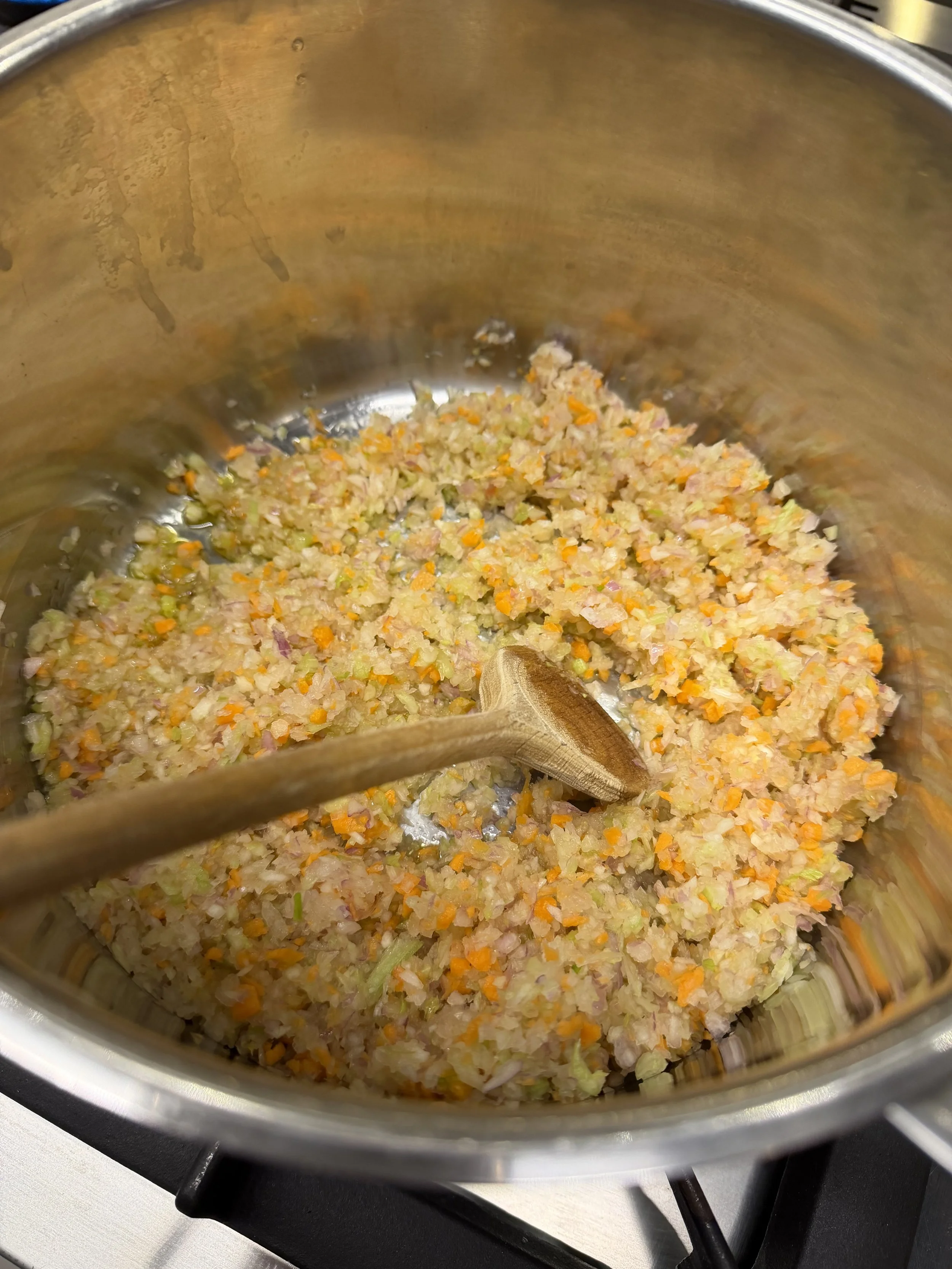
The ortolano sauce was then prepared by a slow layering of vegetables, beginning with the ones that needed the longest time to cook (carrots and celery) and ending with those that needed the shortest cooking time (zucchini and asparagus).

The preparation was simply a matter of stirring, adding small amounts of broth to keep the veggies from sticking, and layering in the other veggies.  The final sauce was more vegetable than liquid - just moist enough to coat the pasta squares.

Nepitella has small green leaves and tiny purplish flowers.

Seasoning was simple – the flavorful olive oil used to begin cooking the vegetables, salt, pepper, a little garlic, and some nepitella.  Nepitella is a wild herb in the mint family, it can be found growing in rock crevices.  It has a pungent, herby flavor so just a little bit will do.   

To put the dish together, the pasta squares were briefly cooked in boiling water, drained, and tossed in the pan with the salsa ortolano.

Once plated, it was finished with a sprinkle of Parmigiano Reggiano cheese.  The simple sauce, bright and colorful atop the green maltagliata pasta, went well with a glass of white wine. 

I am spending a few weeks in New Mexico visiting family and will definitely make this dish while I am there.  I won’t be able to find nepitella, but pinches of basil, thyme, and mint will be a good substitute.   I will also likely use store bought fresh pasta squares, plain or spinach (why? because I am a bit pigra - lazy), but who knows, perhaps I will be inspired to make homemade pasta too.   As for the veggies – asparagus won’t be in season, but mushrooms will be wonderful in this pasta.  Maybe some butternut squash or thinly sliced Brussel sprouts. The possibilities are endless!  And isn’t it good to start the new year off with a healthy, veggie topped pasta?

Buon anno e buon appetito !

If looking for cooking classes near Lucca or Florence, The Olive Press Kitchen is a great choice.

email: info@theolivepresskitchen.com call or WhatsApp : +39 329 743 3364